Why It Is So Hard to Catch a Machiavellian Master Manipulator (And How to Spot Them)
The psychological reason these toxic individuals go undetected for years, and the exact traits to look for before it is too late.


It is notoriously difficult to catch a Machiavellian master manipulator because their tactics rely on calculated deception, deep cynicism, and a strategic separation of emotion from action.
Unlike impulsive toxic personalities, Machiavellians play a long-term game designed to extract resources and avoid exposure, making their exploitation look like ordinary social strategy until it is too late.
Recent psychological research highlights a critical flaw in identifying these individuals: standard personality tests rely on self-reporting.
A true Machiavellian is simply too cunning, and far too guarded, to admit to their exploitative nature on a psychological evaluation, allowing them to slip right through the cracks of both clinical detection and everyday social filters.
Recommended for you
The Two Faces of Manipulation (Approach and Avoidance)
In a 2024 study led by Christian Blötner at the University of Novo Sad, researchers attempted to isolate exactly how Machiavellians operate.
They discovered that true Machiavellianism, inspired by the political philosophies of Niccolò Machiavelli, revolves around two core survival strategies:
- Approach (Resource Acquisition): The aggressive desire to gain power, control others, and extract social or financial value.
- Avoidance (Loss Prevention): The defensive strategy of hiding weaknesses, expecting betrayal, and preemptively manipulating others to avoid being exploited.
To measure this, the team developed the Machiavellian Approach and Avoidance Questionnaire (MAAQ).
But the study revealed a fascinating reality about the human mind: separating a Machiavellian from other dark personalities is incredibly complex.
Why Traditional Psychology Misses the Mark
Psychologists group Machiavellianism alongside narcissism and psychopathy under the Dark Triad.
The problem researchers consistently face is disentangling Machiavellian traits from subclinical psychopathy.
Both personalities manipulate, lie, and exploit.
Pro-Tip from the Field: The reason researchers struggle to isolate Machiavellians on paper is that the test subjects are lying. If you ask an ordinary person if they “enjoy having control over others,” they might find it distasteful and disagree. If you ask a master manipulator the same question, they will deliberately select “strongly disagree” to maintain their mask. They survive by scooting around society’s norms unnoticed.
The Dark Triad Breakdown (Spotting the Difference)
Because Machiavellians share the same psychological space as narcissists and psychopaths, victims often misdiagnose the abuse.
Here is how to distinguish the master manipulator from the rest of the Dark Triad:
| Personality Trait | Primary Motivation | Signature Tactic | Greatest Weakness |
|---|---|---|---|
| Machiavellianism | Long-term power, control, and resource extraction. | Strategic deception, patience, and isolation. | Over-calculating, intense paranoia of being exposed. |
| Narcissism | Constant admiration, attention, and ego validation. | Grandiosity, playing the victim, and guilt-tripping. | Highly predictable, easily manipulated by flattery. |
| Psychopathy | Immediate gratification, thrill-seeking, and dominance. | Impulsivity, intimidation, and blatant rule-breaking. | Recklessness, prone to getting caught quickly. |
The MAAQ Test (Rate Your Suspects)
While the MAAQ might struggle in clinical self-assessments, it serves as an excellent field guide for observing others.
If you suspect someone in your life is a master manipulator, watch to see if they silently exhibit these core beliefs:
- The Power Drive: They maneuver to give orders and control interpersonal dynamics.
- The Cynical Lens: They believe anyone who trusts completely is asking for trouble.
- The Hidden Malice: They assume people are only friendly because of ulterior motives.
- The Armor: They refuse to show weakness, convinced it will be immediately weaponized against them.
How the Machiavellian Operates in the Wild
A Machiavellian does not act like a cartoon villain. They are the helpful coworker, the charming new partner, or the dutiful sibling.
Their manipulation is always highly contextual.
The Workplace (The Corporate Chess Player)
In a professional environment, a Machiavellian rarely yells or demands attention. Instead, they position themselves as the indispensable confidant to leadership.
They will identify the most talented person on the team, quietly take credit for their ideas, and simultaneously start a whisper network to cast doubt on that person’s emotional stability.
If a project fails, the Machiavellian has already laid the groundwork weeks in advance to ensure the blame falls entirely on someone else.
Romantic Relationships (The Calculated Investment)
While a narcissist seeks a partner for adoration, a Machiavellian seeks a partner for utility.
The romance is an acquisition. They look for individuals with resources, social standing, or a high capacity for empathy.
The relationship begins with intense mirroring to secure trust. Once locked in, the Machiavellian begins the “Avoidance” strategy: they slowly dismantle their partner’s outside friendships and financial independence to ensure the partner cannot leave once the exploitation becomes obvious.
Family Dynamics (The Information Broker)
Within a family unit, a Machiavellian survives by controlling the flow of information.
They are the sibling who insists on managing the aging parent’s finances, not out of love, but to secure the inheritance.
They maintain their power by triangulating relatives, telling one sibling a fabricated story about another.
By keeping the family divided and untrusting of one another, the Machiavellian remains the only undisputed authority figure in the household.
The Camouflage of a Master Manipulator
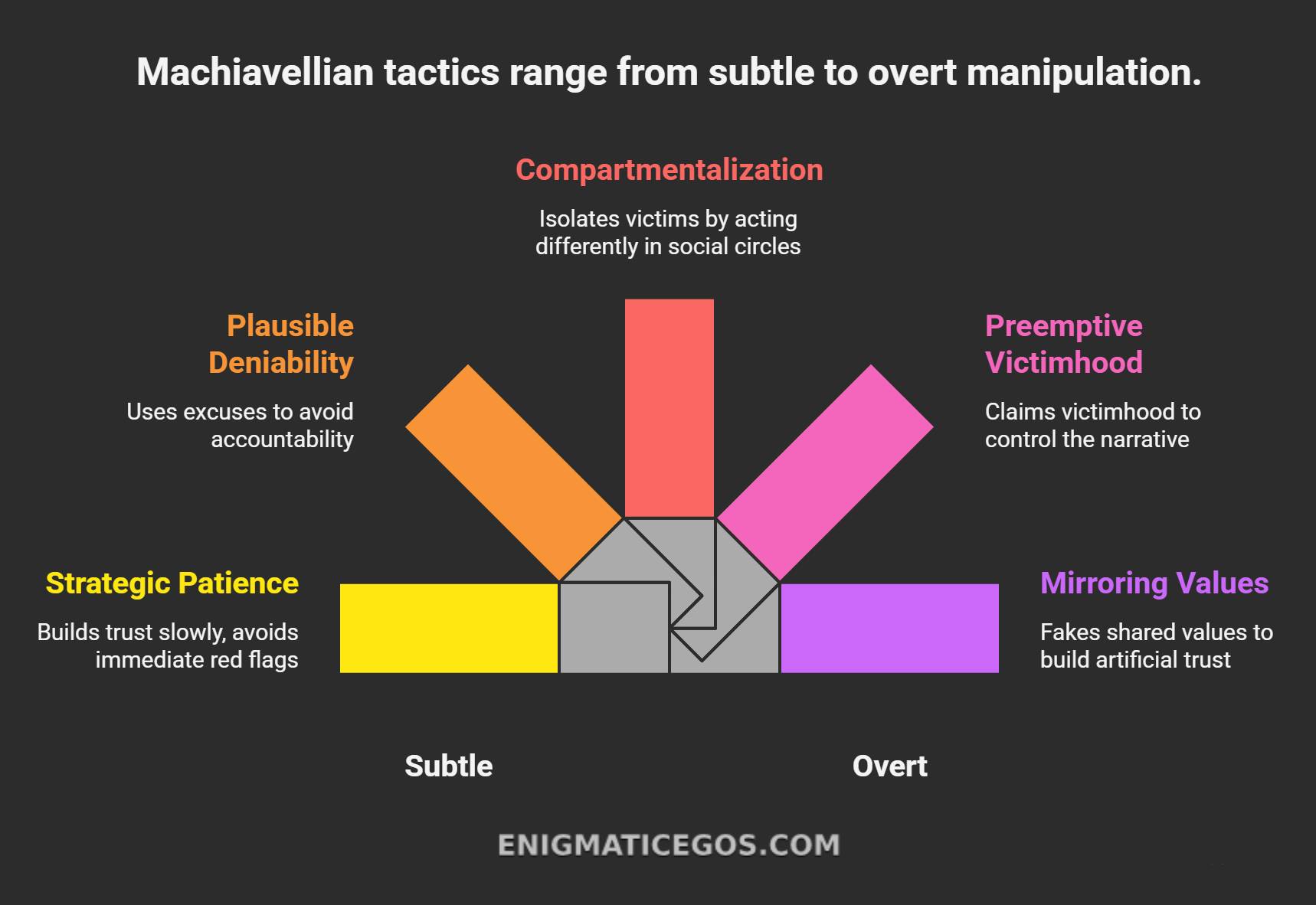
| The Machiavellian Tactic | How It Looks to the Victim | Why It Evades Detection |
|---|---|---|
| Strategic Patience | A supportive, understanding friend taking their time to build a deep connection. | They do not show the impulsive, explosive red flags typical of other toxic personalities. |
| Plausible Deniability | “Just a joke,” a simple misunderstanding, or a slip of the tongue. | They rarely leave concrete proof of malice in writing, making accusations sound like overreactions. |
| Compartmentalization | Acting completely differently depending on which social circle they are currently interacting with. | Victims are kept isolated from one another, making it impossible to compare notes and corroborate the abuse. |
| Preemptive Victimhood | They warn you early on about all the “crazy” or “abusive” people in their past. | By claiming the victim role first, they force the actual victim into a defensive position when the manipulation begins. |
| Mirroring Values | Finding a “soulmate” who perfectly aligns with your deepest morals and beliefs. | The manipulator fakes shared values to manufacture artificial trust and bypass your natural boundaries. |
How to Protect Yourself
You cannot rely on a master manipulator to out themselves. Their entire personality framework is built on flying under the radar while isolating you from trusted allies, like convincing you to drop a mutual friend over fabricated drama.
To protect yourself, stop looking for overt aggression and start looking for cynical control.
Evaluate people based on their actions over time, not their charming words.
If a relationship consistently leaves you socially isolated or emotionally drained while they remain completely shielded, you are likely dealing with a Machiavellian.
Conclusion (Trust Patterns Over Promises)
A Machiavellian master manipulator relies on your empathy and your willingness to give them the benefit of the doubt.
They are statistically unlikely to fail a clinical personality test, and they will certainly never admit to their calculated deception in an argument.
Before you close this page, remember these final rules of engagement:
- Watch the hands, not the mouth: Ignore their charming explanations and focus entirely on the long-term results of their actions.
- Guard your inner circle: If someone insists that everyone else in your life is toxic, they are usually trying to isolate you for easier control.
- Disengage, do not debate: You cannot out-manipulate a master. Your strongest weapon is strict boundary-setting and emotional detachment.
Instead of waiting for a confession or an apology that will never arrive, look at the reality of your situation.
If a relationship consistently leaves you drained, isolated, and confused, it is time to stop analyzing their psychology and start protecting your peace.
The ultimate defense against a Machiavellian is a complete refusal to play their game.
Frequently Asked Questions (FAQ)
What is a Machiavellian personality?
A Machiavellian personality is characterized by a cynical disregard for morality, a focus on self-interest, and the use of strategic manipulation and deception to gain power or resources.
How is Machiavellianism different from psychopathy?
While both manipulate, psychopathy is often characterized by impulsivity, lack of empathy, and thrill-seeking. Machiavellianism is strategic, calculated, patient, and highly focused on long-term resource acquisition.
How do you outsmart a Machiavellian manipulator?
The best way to outsmart a Machiavellian is to deny them resources and emotional reactions. Set strict, unmovable boundaries, verify their claims independently, and avoid sharing personal vulnerabilities that they can use as leverage.
Why do Machiavellians isolate their victims?
Isolation is a form of control. By turning you against trusted friends or family members, the manipulator ensures you rely solely on their narrative, making it easier to exploit you without outside interference.
Did you find an error in this article? Email: [email protected].

Forget the myth of the unfeeling robot. True ancient philosophy is about mastering your inner world and your ego, not burying your humanity.